

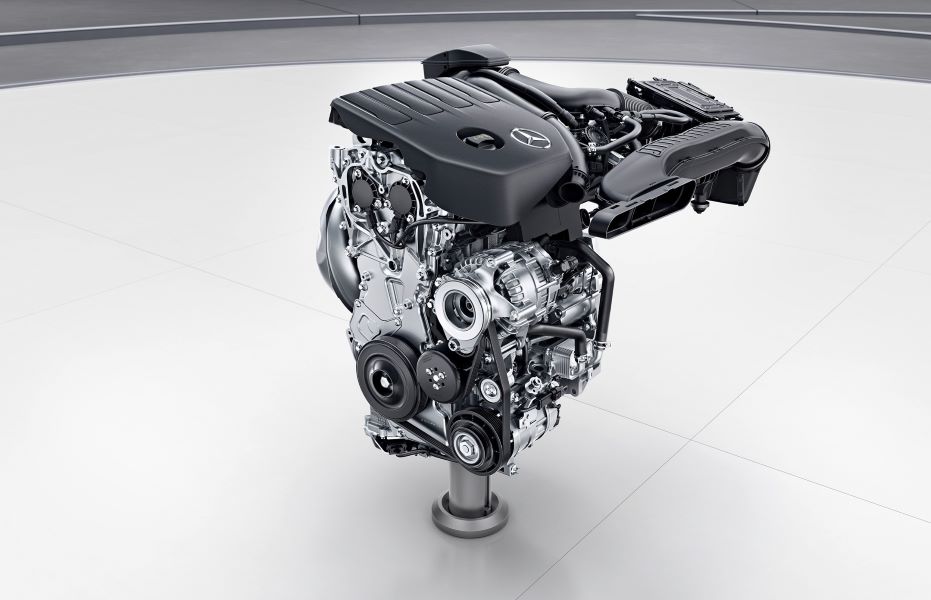
Quick summary The Mercedes M282 is a 1.3L transverse-mounted turbocharged inline-4 (2018–present), co-developed with Renault-Nissan. It powers the A-Class W177, CLA W118, GLA H247, and GLB X247. Generally reliable — 150,000-mile examples are achievable — but has well-documented weak points: carbon buildup on intake valves from ~60,000 miles (no fuel wash on DI engines), thermostat housing gasket failure (P0128, P0597), AC compressor oil leaks at the crankshaft front seal, and cam/crank correlation faults on no-start cases (P0340, P0016). All preventable with the right service schedule.

Mercedes M282 1.3L Turbo Engine (2018–Present)
The M282 is Mercedes-Benz’s entry-level turbocharged petrol engine for its compact car range, introduced in 2018 as a co-development with Renault-Nissan. It replaced the earlier M270 in the lower-displacement role and is built around a transverse-mounted, all-aluminium, direct-injection inline-4 architecture with a twin-scroll turbocharger.
Despite its small 1.3-litre displacement, the M282 covers 109 PS to 163 PS across three output variants and meets Euro 6d-TEMP emissions requirements through a combination of gasoline particulate filter (GPF), cylinder deactivation at low loads, and advanced injection mapping. Co-development with Renault-Nissan means the block is shared with the Renault 1.3 TCe family — a point worth knowing when sourcing parts.

M282 Variants & Specifications
The M282 family covers three output levels under the DE14 designation. The suffix “LA” (Ladeluftkühler) denotes the higher-output variant with an upgraded turbo and intercooler calibration.
| Variant | Power / Torque | Key Features | Applications |
|---|---|---|---|
| M282 DE14 (80 kW) | 109 PS / 180 Nm | Entry-level efficiency, standard intercooler | A180, CLA180, B180 |
| M282 DE14 (100 kW) | 136 PS / 200 Nm | Balanced city/highway, cylinder deactivation | A180 / CLA180, GLA200 |
| M282 DE14 LA (120 kW) | 163 PS / 250 Nm | Larger turbo, upgraded intercooler, highest output | A200, CLA200, GLB200 |
Core technologies: Aluminium open-deck block · Direct injection with carbon-coated cylinder bores · Twin-scroll turbocharger · Cylinder deactivation (2-cylinder shut-off at low load) · Gasoline particulate filter (GPF) · 7-speed dual-clutch transmission (7G-DCT) in all applications

Reliability of the M282
The M282 is a relatively young engine — the oldest examples are now approaching 7–8 years and 80,000–100,000 miles — and the workshop data available reflects that. On the whole it is a well-built unit. The aluminium block is lighter and stiffer than the outgoing M270, and the emissions equipment works without significantly impacting drivability when properly maintained.
The problem areas that have emerged are predictable and manageable. Carbon buildup is an inherent characteristic of any direct-injection engine without port injection. Thermostat housing leaks follow a pattern seen across multiple Mercedes engine families. The AC compressor oil leak issue is specific to the M282’s packaging layout. None of these are terminal — all are diagnosable and fixable at reasonable cost.
✅ Strengths
- Lightweight, stiff aluminium block
- Euro 6d-TEMP compliant
- Smooth power delivery for urban driving
- 150,000+ mile lifespan when maintained correctly
⚠️ Known Weaknesses
- Carbon buildup (DI, no port injection)
- Idle vibration at low load
- Thermostat housing gasket failure
- AC compressor / crankshaft front seal oil leaks
Common M282 Problems & Fault Codes
The four problems below account for the majority of M282 workshop visits. Each entry includes the XENTRY or Autel MaxiSys fault codes, live data values from confirmed cases, and the correct repair approach.
M282 Problem Frequency by Model
The same four fault patterns appear across all M282-equipped models, but the frequency and priority differs depending on the vehicle’s duty cycle and weight.
| Model | M282 Variant | Most Frequent Issue | Notes |
|---|---|---|---|
| A180 / A200 (W177) | 80 kW / 120 kW | Carbon buildup, idle vibration | High rate of short-trip / urban use accelerates carbon deposits |
| CLA180 / CLA200 (W118) | 80 kW / 120 kW | Thermostat housing gasket, coolant warning | Housing gasket failure documented from ~55,000 miles |
| GLA200 (H247) | 100 kW | AC compressor oil leak, fuel trim faults | Higher load cycle than A/CLA increases front seal wear rate |
| GLB200 (X247) | 120 kW (DE14 LA) | No-start, cam sensor / P0016 | Heavier vehicle = higher low-rpm load on timing drive components |
Workshop Case Studies — M282 Engine
Two confirmed workshop cases on M282-powered vehicles. Both include full scan data, diagnostic steps and confirmed repair outcome.
M282 Engine Oil Capacity

| Variant | Capacity (with filter) | Approved Spec | Viscosity | Interval |
|---|---|---|---|---|
| M282 DE14 (80 kW) | 5.4 L | MB 229.5 / 229.51 | 5W-30 | 10,000 mi / 12 months |
| M282 DE14 (100 kW) | 5.4 L | MB 229.5 / 229.51 | 5W-30 or 0W-40 | 10,000 mi / 12 months |
| M282 DE14 LA (120 kW) | 5.4 L | MB 229.5 / 229.51 | 5W-30 or 0W-40 | 10,000 mi / 12 months |
M282 Thermostat: Function & Issues

The M282 thermostat regulates engine operating temperature by controlling coolant flow between the engine block and radiator. Unlike earlier Mercedes engines where the thermostat is a separate serviceable component, the M282 integrates the thermostat element, coolant temperature sensor and bypass circuit into a single plastic housing assembly.
This design reduces the number of cooling circuit connection points but creates a single-point failure. When the housing fails — whether at the gasket, the element or the bypass valve — the entire assembly requires replacement.
- Normal operating temperature: 87–90°C
- Failure mode 1 — stuck open: Engine never reaches target temp → ECU runs rich fuelling correction → increased fuel consumption, P0128
- Failure mode 2 — stuck closed: Rapid overheating, head gasket risk within minutes of driving
- Failure mode 3 — housing gasket: External coolant leak, air enters system, erratic temperature readings
Always replace the complete housing assembly with an OEM part. Inspect all coolant hoses at the same time. Full replacement guide: Leaking Thermostat Housing: Replace It Easily.
M282 Maintenance Checklist
| Task | Interval | Priority |
|---|---|---|
| Oil & filter change — MB 229.5 approved | 10,000 mi / 12 months (6,000 mi for short-trip or urban use) | Critical |
| Walnut blast — intake valves and manifold | 50,000–60,000 miles, or at first rough idle symptom | Critical |
| Coolant system inspection and pressure test | Every service | High |
| Thermostat housing inspection | At first temperature symptom, or 80,000 miles preventively | High |
| AC compressor and crankshaft front seal check | 60,000 miles or on unexplained oil consumption | High |
| Spark plugs | 30,000–40,000 miles | Standard |
M282 Engine Tuning Potential
The M282’s twin-scroll turbo setup gives it more tuning potential than its displacement suggests. The DE14 LA (120 kW) variant in particular has significant factory headroom — the same block produces substantially more power in Renault Sport applications, which confirms the bottom end is capable of handling more.
- Stage 1 ECU remap (DE14 LA): 185–195 PS achievable on the standard turbo. Fuel trims and boost control remain within safe limits. Warranty voided.
- Stage 2: Upgraded intercooler, intake and exhaust reduce charge temperatures and improve flow. Gains to ~215 PS possible. Requires dyno mapping.
- Open-deck block limitation: The aluminium open-deck design limits how far boost pressure can be safely raised without internal reinforcement. Keep below 1.4 bar for a daily-driven road car.
- Caution: Higher boost accelerates carbon buildup and increases thermal load on the thermostat system. Reduce walnut blast interval to 40,000 miles on tuned cars.
Which Cars Have the M282 Engine?
- Mercedes A-Class (W177) — A180, A200
- Mercedes CLA (W118) — CLA180, CLA200
- Mercedes GLA (H247) — GLA200
- Mercedes GLB (X247) — GLB200
Explore All Mercedes Engine Types
The M282 is one of multiple engine families covered in our complete guide — compare specs, reliability data and known fault patterns across all current Mercedes petrol and diesel engines.
→ Mercedes Engine Types HubRelated M282 Case Studies & Repair Guides
- → Check Coolant Level: CLA118 Case Study
- → Mercedes Not Starting: CLA118 Case Study
- → Engine Cranking But Not Starting
- → Fuel Needle Not Working
- → Oil in Coolant: Case Study & Fix
- → Coolant Light: Solution with Case Study
- → Leaking Thermostat Housing: Replace It
- → Check Engine Light On: Fix It Quickly
- → Engine Vibration: Diagnosis & Repair
- → Overheating Caused by Oil in Coolant
FAQs — Mercedes M282 Engine
Is the Mercedes M282 a reliable engine?
Yes — with correct servicing it is a solid unit. The main reliability risk is carbon buildup from neglected oil changes and short-trip driving. Keep to 10,000-mile oil change intervals, walnut blast the intake valves at 60,000 miles, and the M282 will comfortably reach 150,000+ miles.
What is the oil capacity of the M282 engine?
All M282 variants take 5.4 litres with filter. Use only MB 229.5 or 229.51 approved fully synthetic oil — 5W-30 is the standard grade, 0W-40 is approved for colder climates or performance use. Do not mix specifications.
Does the M282 suffer from carbon buildup?
Yes — like all direct-injection engines, the M282 has no fuel wash on intake valves. Carbon from blow-by gases accumulates progressively and causes rough idle, misfires (P0300/P0301/P0302) and flat spots. A walnut blast service every 50,000–60,000 miles prevents the problem from affecting drivability.
What fault codes are most common on the M282?
The most frequently seen codes are P0300/P0301/P0302 (misfires from carbon buildup), P0128 and P0597 (thermostat circuit — housing gasket or element failure), and P0340 with P0016 (cam/crank correlation, typically on no-start cases from cam sensor or timing chain wear).
Which Mercedes models use the M282 engine?
The M282 powers four models in Mercedes’s compact car range: the A-Class (W177) as A180 and A200, the CLA (W118) as CLA180 and CLA200, the GLA (H247) as GLA200, and the GLB (X247) as GLB200. All use the same 1.3-litre DE14 block in three output configurations.
Is the M282 good for tuning?
The DE14 LA (120 kW) variant has the strongest tuning potential. A Stage 1 ECU remap typically delivers 185–195 PS on stock hardware. The open-deck aluminium block sets a practical limit on how far boost can be raised safely — keep below 1.4 bar for a road car. All tuning voids the Mercedes warranty.
— Salim, Mercedes Expert
Independent specialist in Mercedes-Benz diagnostics, CAN Bus analysis, troubleshooting case studies, and EV systems.