

Table of Contents
Mercedes No Power When Accelerate : Real Case Study on Mercedes C Class W205 (M264 Engine)
A sudden loss of power when accelerating is one of the most common and frustrating issues Mercedes-Benz owners experience especially on turbocharged engines like the M264. When boost pressure drops or airflow becomes restricted, the vehicle can feel sluggish, fail to respond properly to throttle input, and even enter limp mode.
This real-world case study shows exactly how a Mercedes technician diagnosed and repaired a Mercedes C Class W205 with no power when accelerating, and how the faulty component was identified.
For more troubleshooting steps, diagnostic workflows, and similar case studies, see the master guide:
Mercedes Power Loss and Limp Mode: Full Troubleshooting Guide
Case Study Overview
Model: Mercedes-Benz C Class W205
Engine: M264 Turbocharged
Customer Complaint: Mercedes has no power when accelerate / low power when accelerating
The driver reported that the vehicle struggled to gain speed, especially under high load or while overtaking. A Check Engine Light was also intermittently present.
Step 1 : Diagnostic Scan with Xentry STAR
The technician connected the vehicle to Xentry STAR, Mercedes’ official diagnostic tool.
Fault Codes Found:
=> Low boost pressure
This confirmed the ECU detected insufficient turbocharger boost, a common cause of:
- – Poor acceleration
- – Turbo lag
- – Limp mode
- – High fuel consumption
With low boost confirmed, the technician proceeded to identify the cause.
Step 2 : Identifying Possible Causes of Low Boost Pressure
Mercedes turbo engines can lose boost due to:
1. Air Leak in Intake System
A loose clamp, cracked hose, or leaking intercooler pipe can instantly drop boost.
➡ Inspection Result: OK ; No air leaks found
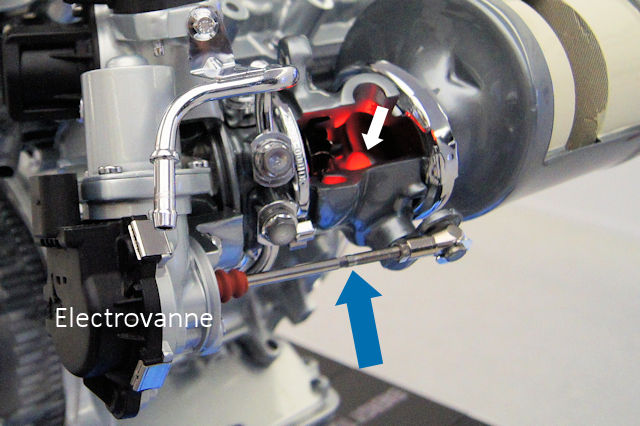
2. Malfunctioning Wastegate
A stuck wastegate prevents the turbo from building pressure.
➡ Inspection Result: Wastegate actuator working properly
3. Vacuum Circuit Leak
Turbo control actuators rely on vacuum. Any leak here reduces boost.
➡ Inspection Result: Vacuum circuit OK
4. Turbocharger Failure
If the turbocharger becomes blocked, damaged, or seized, the engine cannot generate sufficient boost pressure.
➡ Inspection Result: Turbocharger was blocked / seized internally
This was the root cause of the Mercedes having no power when accelerating.
Step 3 : Confirming Turbocharger Failure
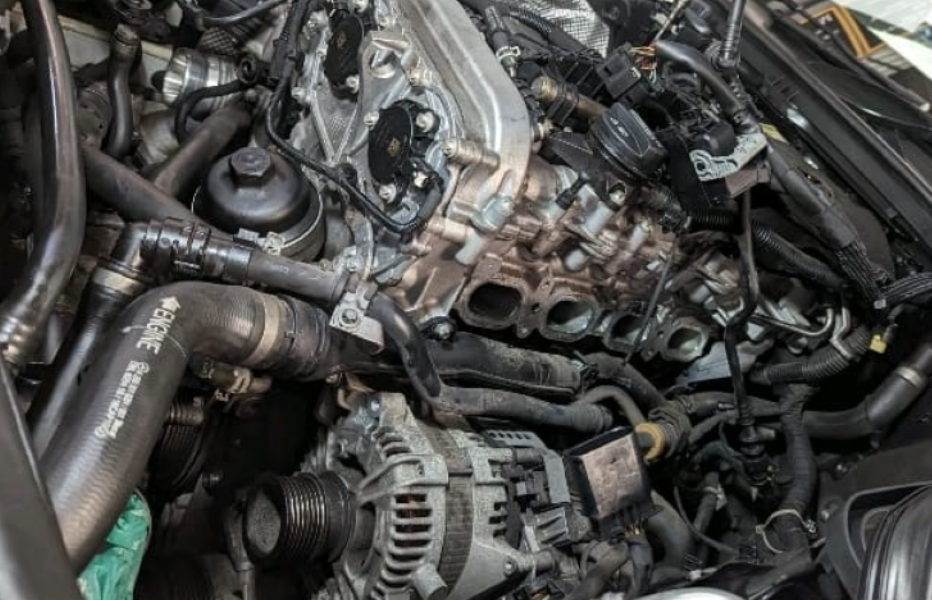
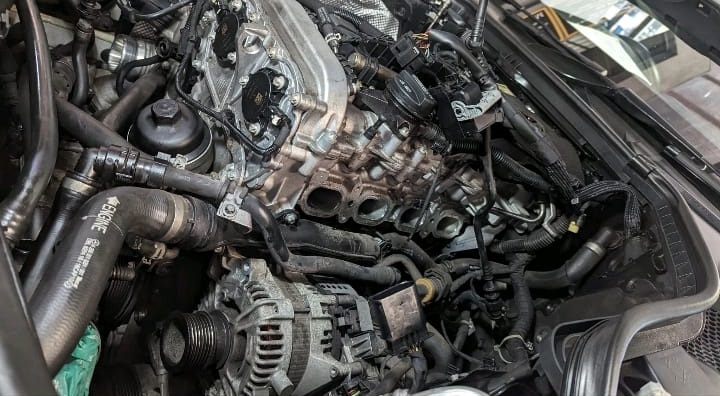
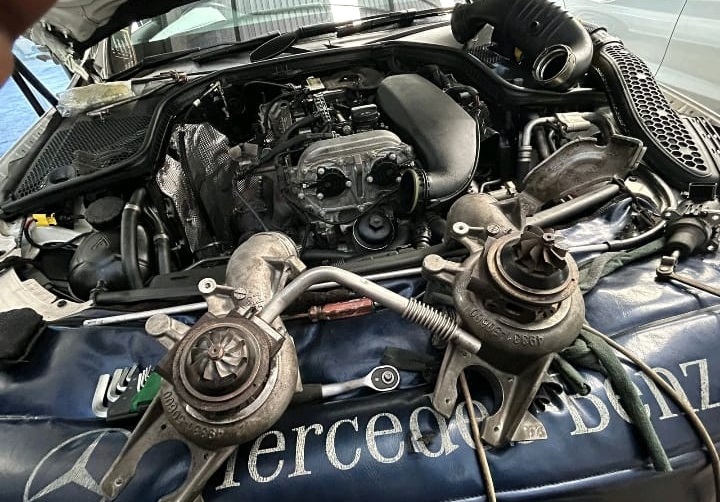
After removing the turbocharger assembly, the technician found:
- – Restricted turbine movement
- – Carbon/oil contamination
- – Internal blockage
- – Poor spinning at idle test
A blocked turbo cannot compress air, which is why the engine produced low boost and felt weak during acceleration.
Step 4 : Turbocharger Replacement
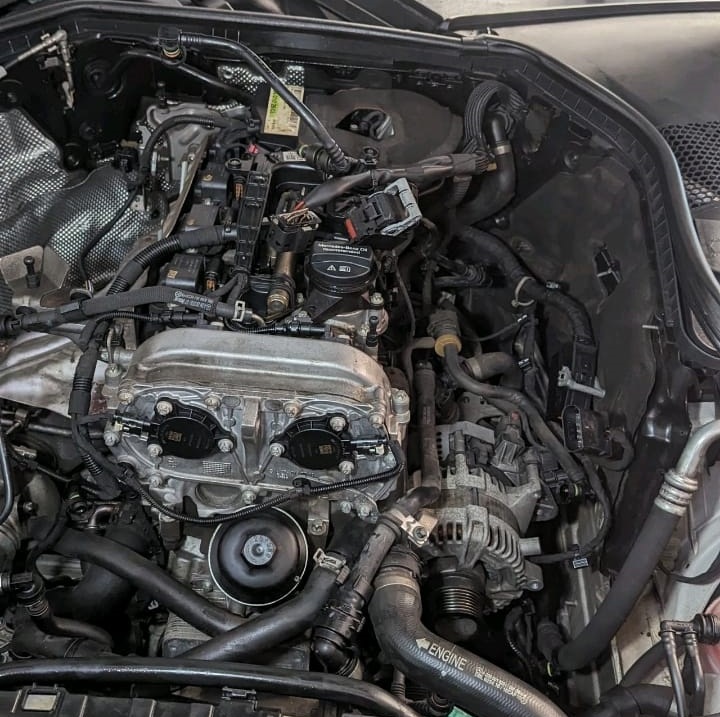
The technician replaced the faulty turbocharger with a new OEM unit.
Turbo Replacement Included:
– Removing intake and exhaust connections
– Disconnecting oil feed and return lines
– Removing coolant lines (if applicable)
– Cleaning intercooler pipes from oil residue
– Installing new turbo with fresh gaskets
– Priming turbo with oil before first start
– Resetting boost adaptations in Xentry
– Clearing all fault codes
Post-Repair Verification
After installing the new turbo:
✔ Xentry Boost Learning Performed
Ensured the ECU adapted to the new turbo characteristics.
✔ Road Test
- – Acceleration fully restored
- – No hesitation
- – No turbo lag
- – No boost-related fault codes returned
- – Engine delivered full power under all loads
The customer confirmed the vehicle now accelerated normally.
Conclusion
This case study shows how a blocked turbocharger can cause Mercedes no power when accelerate symptoms and trigger persistent low-boost warnings. Using Xentry STAR and methodical system checks allowed the technician to isolate the failure quickly and accurately.
If your Mercedes lacks power during acceleration, the most common causes include:
- – Boost leak
- – Wastegate malfunction
- – Turbocharger failure
- – Vacuum leak
- – Faulty MAF sensor
- – Clogged catalytic converter
- – EGR malfunction
A systematic diagnostic approach is essential.
For complete troubleshooting workflows, more power-loss case studies, and expert guidance, visit:
Mercedes Power Loss and Limp Mode: Full Troubleshooting Guide
— Salim, Mercedes Expert
Independent specialist in Mercedes-Benz diagnostics, CAN Bus analysis, troubleshooting case studies, and EV systems.