

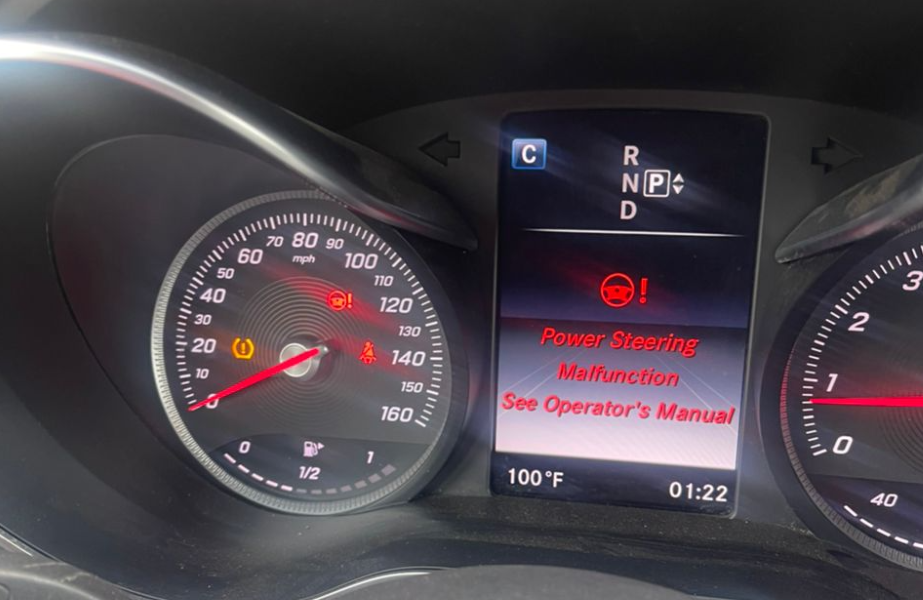

What P063500 & P0635 Actually Mean
When Mercedes displays “Power Steering Malfunction See Operator’s Manual”, the EPS control module has stored one or both of these fault codes:
| Fault Code | Description | What it means in practice |
|---|---|---|
| P063500 | Power Steering Control Circuit — Overheating / Electrical Fault | Mercedes-specific extended code. EPS module detected sustained overheating or control circuit anomaly. Most common on W205 and W213. |
| P0635 | Power Steering Control Circuit | Base OBD code. ECU detected abnormality in EPS control circuit — voltage, current, or communication fault. |
Both codes point to the same system: the Electric Power Steering (EPS) control circuit. Unlike older hydraulic steering systems, Mercedes EPS has no fluid — it relies entirely on electrical power, sensor data, and CAN/FlexRay communication. Any disruption to voltage supply, ground integrity, or module communication disables power assist instantly.

Model-Specific Causes — W205, W213, W222, W176
P063500 behaves differently across platforms. Here is what we see most in the workshop for each model:
W205 C-Class — C200, C300, C220d (2014–2021)
The W205 is the most common platform for P063500 in our workshop. The primary culprit is the EPS connector corrosion — the connector on the EPS motor/rack unit is exposed to road splash and moisture from below. Pin oxidation creates high resistance in the control circuit, which the ECU interprets as an overheating condition and stores P063500.
Workshop pattern: The fault is often intermittent at first — steering assist cuts out after 10–15 minutes of driving (when the EPS warms up and resistance increases), then returns after cooling. This intermittent pattern almost always means the connector, not the motor. Clean and treat the connector before any further steps.
Second most common cause on W205: weak 12V battery. The EPS on the W205 requires stable voltage above 12.4V to function. A battery with reduced capacity — even one that starts the car normally — can cause voltage dips under load that trigger P063500. Always test the battery with a proper load tester, not just a voltmeter.
W213 E-Class — E200, E300, E220d (2016 onward)
On the W213, P063500 is more often caused by CAN Bus communication faults between the EPS module (N68) and the chassis control systems than on the W205. The W213’s more complex ADAS integration means an EPS fault can be triggered by issues in adjacent systems — particularly if there are simultaneous faults in the ESP or lane-keeping assist modules.
Workshop tip: On W213, always perform a full system scan — not just the EPS module. A single fault in the chassis domain can cascade into a P063500. If you find multiple chassis faults alongside P063500, resolve the other faults first and retest EPS before replacing any steering components.
The W213 EQ Boost variant (with 48V mild hybrid) adds complexity — the 48V system has its own voltage domain that can affect EPS if the 48V battery or DC-DC converter has issues.
W222 S-Class — S300, S350d, S500 (2013–2020)
The W222 uses a more sophisticated rear-wheel steering system alongside the front EPS. P063500 on the W222 is the highest-risk fault to ignore — at the kerb weight of 1,800–2,200 kg, loss of power steering assist is genuinely dangerous at low speed. The steering becomes extremely heavy.
Most common cause on W222: EPS motor thermal protection shutdown. The W222 EPS motor works harder due to vehicle weight, and on vehicles used predominantly in urban stop-start traffic, the motor can overheat and trigger P063500 as a protective measure. The fault clears after cooling but returns under the same conditions. This pattern requires EPS motor replacement — the thermal threshold has degraded.
W176 A-Class — A180, A200, A220 (2012–2018)
On the W176, P063500 and power steering malfunction are most commonly caused by ground point failure. The W176 has a known weak ground point on the front subframe near the EPS rack. Corrosion at this ground increases resistance in the EPS earth circuit, causing the module to misread operating conditions and store P063500.
Quick test: Measure resistance between the EPS module ground pin and battery negative — should be under 0.1Ω. Above 0.5Ω indicates ground degradation. Clean and re-torque the subframe ground strap before any other repair.
Also check the older C-Class W204 — the same ground point issue affects W204 late models with EPS.
Real Workshop Case Study: Mercedes C300 W205
The following is a real case from our workshop — a Mercedes C300 (W205) presented with intermittent power steering malfunction that eventually became permanent.
| Detail | Value |
|---|---|
| Model | Mercedes-Benz C300 (W205) |
| Complaint | Intermittent then permanent “Power Steering Malfunction” warning |
| Fault codes stored | P0635, P063500 |
| Steering behaviour | Assist lost after ~15 min driving, returns after 20 min cooling |
- 1Full XENTRY scan: P0635 and P063500 confirmed active in the EPS (N68) module. No other chassis faults present — ruling out CAN cascade from adjacent systems.
- 2Battery load test: Battery voltage 12.6V at rest but dropped to 11.8V under EPS load — below the 12.4V minimum threshold. Battery flagged as weak. However, the fault pattern (15-min onset) was inconsistent with a pure voltage issue.
- 3EPS connector inspection: Connector on the EPS motor unit showed visible pin oxidation and moisture residue. This was the primary fault — high resistance in the control circuit triggered the overheating protection (P063500) after the motor warmed up.
- 4XENTRY live data: EPS motor temperature reading showed values climbing to 95°C within 12 minutes of driving despite ambient temperature of 22°C — confirming the connector resistance was causing the module to misread operating temperature.
- 5Repair: EPS connector cleaned, treated with dielectric grease, and reseated. Battery replaced (secondary issue). Fault codes cleared. XENTRY EPS re-initialisation performed.
- 6Result: Test drive of 45 minutes including repeated low-speed parking manoeuvres. EPS temperature remained stable at 45–55°C. P063500 did not return. Fault confirmed resolved.

Step-by-Step Diagnostic Guide — P063500 / P0635
Follow this sequence. Each step eliminates a cause before moving to a more expensive one:

| Step | Check | Tool | Pass | Fail → Action |
|---|---|---|---|---|
| 1 | 125A EPS pre-fuse | Visual / multimeter | Fuse intact, continuity confirmed | Replace fuse — retest. If it blows again, EPS motor has short circuit. |
| 2 | Battery load test | Battery load tester | >12.4V under EPS load | Replace battery. Retest before further diagnosis. |
| 3 | EPS connector inspection & cleaning | Visual + dielectric grease | Clean pins, no corrosion, firm seating | Clean pins, treat with dielectric grease, reseat connector. Clear codes, retest. |
| 4 | Ground resistance (EPS to battery −) | Multimeter | <0.1Ω | Clean and re-torque EPS ground strap on subframe. |
| 5 | Voltage at EPS connector under load | Multimeter / XENTRY live data | >12.4V sustained | Trace voltage drop — wiring harness or alternator fault. |
| 6 | XENTRY EPS live data — motor temp | XENTRY | Stable, proportional to ambient | Rapid temperature rise with clean connector = EPS motor internal fault → replace. |
| 7 | CAN/FlexRay communication check | XENTRY full scan | No communication faults in chassis domain | Resolve communication faults before EPS repair. |
| 8 | Software update check | XENTRY | EPS module on latest software | Apply available software update — some P063500 faults are software-related on 2018+ models. |
Symptoms of Mercedes EPS Failure
- Heavy or stiff steering — most noticeable at parking speeds and low-speed manoeuvres. On W222 S-Class, this is particularly pronounced due to vehicle weight.
- Intermittent assist loss — steering assist cuts out after 10–20 minutes of driving and returns after cooling. Classic sign of connector resistance or early motor thermal degradation.
- Warning message on instrument cluster — “Power Steering Malfunction See Operator’s Manual” with red steering wheel icon.
- Whining or squealing noise when turning — indicates EPS motor working under abnormal load or bearing wear.
- Multiple simultaneous warnings — ESP, ABS, and steering warnings together usually indicate a voltage or CAN Bus issue rather than a dedicated EPS fault.
- Fault returns after clearing — codes clear but return within one drive cycle. Persistent fault = mechanical or connector fault, not a software glitch.
All Common Causes & How to Identify Them
| Cause | Symptoms | How to identify | Fix |
|---|---|---|---|
| EPS connector corrosion | Intermittent fault after warm-up, clears after cooling | Visual inspection of connector pins — oxidation, moisture | Clean pins, dielectric grease, reseat. Most common fix on W205. |
| Weak / failing battery | Multiple warnings, fault on cold mornings or under load | Battery load test — measure voltage under EPS load | Replace battery — often resolves P063500 completely. |
| Blown 125A EPS pre-fuse | Sudden total EPS loss, no warning before | Visual inspection of engine bay fuse box | Replace fuse. Investigate cause if it blows again. |
| EPS motor internal failure | Permanent fault, does not clear after cooling | XENTRY live data — rapid temperature rise, motor resistance out of spec | Replace EPS motor/rack assembly. Requires XENTRY variant coding after. |
| Ground point corrosion | Intermittent, often worse in wet weather | Multimeter — measure resistance EPS ground to battery negative | Clean and re-torque subframe ground strap. |
| CAN/FlexRay communication fault | Multiple chassis warnings simultaneously | Full XENTRY system scan — look for communication faults in chassis domain | Resolve root communication fault. EPS fault usually clears. |
| EPS software fault | Fault appears and disappears without pattern | XENTRY — check EPS module software version vs. latest available | Apply software update via XENTRY. Common on 2018+ W205 and W213. |
| Alternator voltage irregularity | Fault under heavy electrical load (AC, lights, heated seats on) | Measure alternator output — should be 13.5–14.8V | Replace alternator or voltage regulator. |
How Mercedes Electric Power Steering Works
Understanding the EPS system helps diagnose it correctly. Mercedes EPS has no hydraulic fluid — it is a fully electric system consisting of:
- Torque sensor (A91b1): Measures steering wheel input force. Mounted on the steering column, it tells the EPS module how much assist to apply.
- Steering angle sensor: Integrated into the steering column. Provides absolute wheel position to EPS, ESP, and ADAS systems.
- EPS electric motor (A91m1): Applies assist force directly to the steering rack via a ball-screw mechanism. Generates heat under sustained low-speed load.
- EPS control module (N68): Integrated into the rack assembly. Calculates required assist based on torque input, vehicle speed, and wheel speed sensors. Communicates via CAN Bus and FlexRay.
The ECU calculates assist level based on: steering torque input, vehicle speed (less assist at high speed), steering speed, and engine/motor load. At parking speeds, the EPS motor works at maximum duty cycle — this is when connector resistance and motor overheating are most likely to trigger P063500.
For a deeper understanding of related electrical faults including SAM module, CAN Bus, and ECU issues, see our Mercedes Electrical Problems hub.
What to Do If Steering Fails While Driving
- 1Do not panic. The car is still steerable — EPS failure does not cause loss of control. It requires significantly more physical effort to turn the wheel.
- 2Reduce speed gradually and move to the left lane or hard shoulder. Avoid sharp turns at speed.
- 3Pull over safely and switch off the engine completely. Wait 2–3 minutes.
- 4Restart the vehicle. A full power cycle sometimes clears a temporary overheating or voltage fault and restores EPS assist. If it returns within minutes of driving, do not repeat — have the vehicle recovered.
- 5Do not drive at motorway speed without EPS assist — particularly on heavier models (E-Class, S-Class, GLE). The steering effort required is unsafe at high speed.
- 6Scan with XENTRY as soon as possible to identify the stored fault code before it is overwritten.
Frequently Asked Questions — P063500 Mercedes Power Steering
— Salim, Mercedes Expert
Independent specialist in Mercedes-Benz diagnostics, CAN Bus analysis, troubleshooting case studies, and EV systems.