

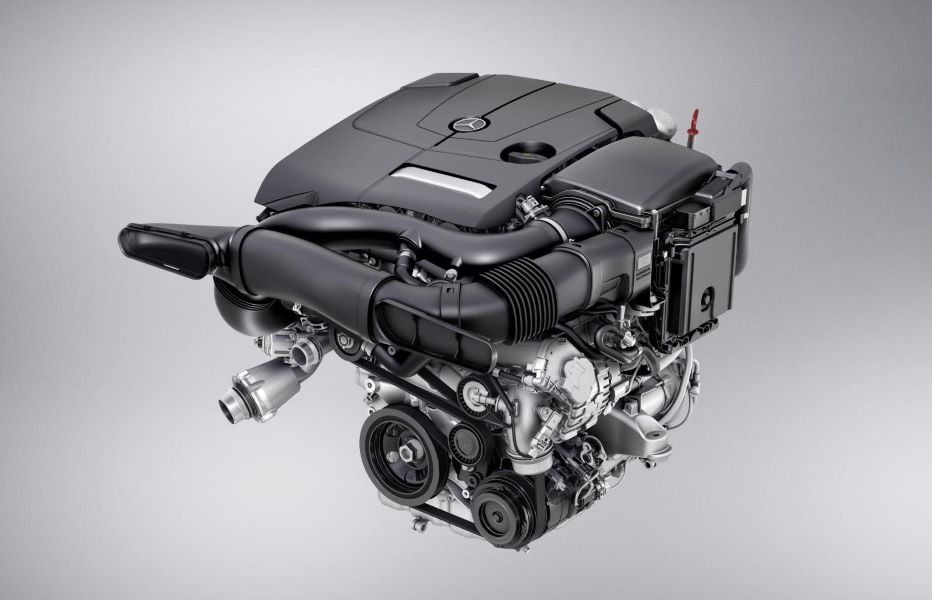
Quick summary The Mercedes M274 is a 1.6L and 2.0L longitudinally-mounted turbocharged inline-4 (2012–2019), powering the C-Class W205, E-Class W213, GLC X253, and SLC R172. Generally reliable — 300,000 km examples are well-documented — but has clear weak points: thermostat housing failure and coolant loss (P0128, P0597), camshaft actuator wear on pre-2014 units (Y49/1, Y49/2), timing chain stretch on neglected oil change intervals, turbo hose cracking and wastegate wear, and isolated piston/wrist-pin noise on certain 2015–2016 DE20 LA units. All preventable or manageable with the right service schedule.

Mercedes M274 Engine — Overview & Fast Facts
The M274 is Mercedes-Benz’s longitudinal 4-cylinder turbocharged petrol engine family, introduced in 2012 to replace the older M271 in the C-Class and E-Class lines. Unlike the closely related M270, which is transverse-mounted for compact FWD models, the M274 is designed for longitudinal RWD and 4MATIC layouts — making it a fundamentally different installation despite sharing core architecture.
It combines piezo direct injection, a twin-scroll turbocharger, an integrated exhaust manifold (reducing warm-up time and emissions), variable cam timing on both camshafts, and hydraulic lifters. The result is a broad, flat torque curve available from under 1,300 rpm — a significant step on from the M271 it replaced.
Closely related engines: M270 (transverse) · M264 48V (successor) · M271 (predecessor)
| Item | Details |
|---|---|
| Layout | Inline-4, aluminium block/head, DOHC, dual-row chain drive |
| Displacements | 1.6 L (DE16 LA, 1,595 cc) · 2.0 L (DE20 LA, 1,991 cc) |
| Induction | Twin-scroll turbo, integrated exhaust manifold |
| Injection | Direct injection (piezo injectors) |
| Power / Torque | DE16: 95–115 kW / 210–250 Nm · DE20: 115–180 kW / 270–370 Nm |
| Bore × Stroke | 83 × 73.7 mm (DE16) · 83 × 92 mm (DE20) |
| Compression | ~10.3:1 (DE16) · ~9.8:1 (DE20) |
| Emissions | Euro 5 / Euro 6 |
| Oil spec | 5W-30 / 5W-40 MB 229.5 or 229.51 · Capacity: 6.0–7.0 L (with filter) |
| Typical lifespan | 300,000 km with correct service intervals |
M274 Variants & Specifications
Two displacement variants cover the full M274 range. The DE20 LA (2.0L) is the most common and is found in the majority of C-Class, E-Class and GLC applications. The DE16 LA (1.6L) appeared in select markets primarily in the C-Class and SLC.
| Variant | Displacement | Power | Torque | Years | Applications |
|---|---|---|---|---|---|
| M274 DE16 LA | 1,595 cc | 95–115 kW | 210–250 Nm | 2012–2019 | C180, C200, SLC (market-dependent) |
| M274 DE20 LA | 1,991 cc | 115–180 kW | 270–370 Nm | 2013–2019 | C250, C300, E200, E250, GLC200/250/300, SLC300 |


Reliability of the M274
The M274 has accumulated a strong long-term reliability record. The move to a dual-row timing chain (versus the single-row setup that caused repeated problems on the M271) is the most significant structural improvement, and it shows in the data — timing chain failures on the M274 are far less common and are almost always linked to extended oil change intervals rather than design fault.
The engine’s weak points are consistent and well-documented at this point. Thermostat housing failures follow a pattern seen across multiple Mercedes engine families. Camshaft actuator wear on pre-2014 part numbers (Y49/1, Y49/2) was addressed with an updated part that resolved the issue on most units. The isolated piston/wrist-pin noise cases on certain 2015–2016 DE20 LA engines are the most serious documented fault — these require a compression and leak-down test, borescope inspection, and in confirmed cases, engine repair or replacement.
✅ Strengths
- Dual-row timing chain — far more durable than M271
- Strong flat torque curve from 1,200 rpm
- 300,000 km lifespan when properly maintained
- Integrated exhaust manifold reduces cold-start wear
- Euro 5 / Euro 6 compliant across all variants
⚠️ Known Weaknesses
- Thermostat housing leaks and element failure
- Camshaft actuator wear (pre-2014 part numbers)
- Timing chain stretch on neglected oil intervals
- Turbo hose cracking and wastegate wear
- Piston/wrist-pin noise on select 2015–16 DE20 LA
Common M274 Problems & Fault Codes
The five problems below account for the overwhelming majority of M274 workshop visits across C-Class, E-Class and GLC applications. Each entry includes XENTRY or Autel MaxiSys fault codes, confirmed live data values, and the correct repair approach.
M274 Problem Frequency by Model

| Model | Variant | Most Reported Issue | Notes |
|---|---|---|---|
| C-Class W205 (C180–C300) | DE16 LA / DE20 LA | Thermostat, cam actuator (pre-2014), piston noise (2015–16) | Highest volume — most case study data available |
| E-Class W212 / W213 | DE20 LA | Turbo hose leaks, boost control faults | Higher mileage examples — turbo plumbing ages faster |
| GLC X253 (GLC200–300) | DE20 LA | Timing chain (neglected service), thermostat | Heavier vehicle, more stress on timing drive at low rpm |
| SLC R172 (SLC200–300) | DE16 LA / DE20 LA | Cam actuator (early cars), oil leaks | Lower volume, but early build dates common |
Workshop Case Studies — M274 Engine
Two confirmed cases on M274-powered vehicles. Full scan data, diagnostic steps, and confirmed repair outcome included in each.
M274 Engine Oil Capacity & Specs

| Variant | Capacity (with filter) | Approved Spec | Viscosity | Change Interval |
|---|---|---|---|---|
| M274 DE16 LA (1.6T) | 6.0 L | MB 229.5 / 229.51 | 5W-30 | 10,000 mi / 16,000 km / 12 months |
| M274 DE20 LA (2.0T) | 6.5–7.0 L | MB 229.5 / 229.51 | 5W-30 or 5W-40 | 10,000 mi / 16,000 km / 12 months |

M274 Maintenance Checklist
| Task | Interval | Priority |
|---|---|---|
| Oil & filter change — MB 229.5/229.51 | 10,000 mi / 12 months (6,000 mi for short trips, hot climate or towing) | Critical |
| Coolant system pressure test and hose inspection | Every service | Critical |
| Thermostat housing inspection | At first temperature symptom, or proactively at 80,000 miles | High |
| Camshaft actuator solenoids check (Y49/1, Y49/2) | 60,000–70,000 miles or at first cold-start rattle | High |
| Turbo boost pressure test and hose inspection | Annual, or at first boost lag / power reduction symptom | High |
| Timing chain inspection (cold-start listen) | At first rattle on cold start — do not delay | High |
| Spark plugs | 30,000–40,000 miles (shorten for short-trip/city use) | Standard |
M274 vs M270 — Key Differences
The M274 and M270 are closely related engines sharing a common design philosophy but built for fundamentally different vehicle layouts. Knowing which you have matters for part sourcing and fault interpretation.
| Feature | M270 | M274 |
|---|---|---|
| Mounting orientation | Transverse (FWD/4MATIC) | Longitudinal (RWD/4MATIC) |
| Typical models | A-Class, B-Class, CLA, GLA | C-Class, E-Class, GLC, SLC |
| Displacements | 1.6L and 2.0L | 1.6L and 2.0L |
| Ancillaries / plumbing | Compact packaging, different hose routing | Longitudinal layout, separate ancillary positioning |
| Timing chain | Dual-row | Dual-row |
| Feel / character | Compact, efficient, urban bias | More performance-oriented, stronger mid-range |
Which Cars Have the M274 Engine?
- Mercedes C-Class (W205) — C180, C200, C250, C300
- Mercedes E-Class (W212) / E-Class (W213) — E200, E250
- Mercedes GLC (X253) — GLC200, GLC250, GLC300
- Mercedes SLC (R172) — SLC200, SLC300
Explore All Mercedes Engine Types
The M274 is one of several engine families covered in our complete guide. Compare specs, reliability data and known fault patterns across all Mercedes petrol and diesel engines — including the successor M264 48V and predecessor M271.
→ Mercedes Engine Types HubRelated M274 Case Studies & Repair Guides
- → Check Coolant Level: C-Class Case Study
- → Check Engine Light Flashing: Case Study
- → Smell of Fuel Inside Car: C300 M274
- → 12V Battery Warning: Case Study
- → Coolant Leak From Engine: Case Study
- → Engine Mount Replacement: Steps & Cost
- → Top Up Coolant — Owner’s Manual Warning
- → Engine Overheating: Easy Solution
- → Engine Coolant Temp Not Displayed
- → Coolant Mixing With Engine Oil
- → P029921 Transmission Delay Shifting
- → Coolant Reservoir Boiling & Overflowing
- → Car Turns Over But Won’t Start
- → Problem With Power Steering
- → Engine Overheating But Coolant Full
- → Engine Light On: Quick Fixes
- → Why Is My Car Overheating?
- → P06DA00: Fix Y130 Oil Pump Valve
FAQs — Mercedes M274 Engine
Is the Mercedes M274 a reliable engine?
Yes — the M274 is one of the more dependable four-cylinder petrol engines in Mercedes’s modern lineup. With strict oil change intervals and proactive thermostat and cam actuator maintenance, 300,000 km is achievable. The dual-row timing chain is a significant improvement over the M271 it replaced. The main risk is the isolated piston/wrist-pin issue on 2015–2016 DE20 LA units, which should be checked on any vehicle from that build period.
What is the best oil for the M274?
Full-synthetic 5W-30 or 5W-40 meeting MB 229.5 or 229.51 specification. Always confirm in your specific owner’s manual — the DE16 and DE20 variants share the same spec but differ slightly in capacity. Do not use off-spec oils; they accelerate cam actuator and timing chain wear on this engine.
How often should I change the oil on the M274?
Every 10,000 miles or 16,000 km or 12 months — whichever comes first. Shorten to 6,000 miles for hot-climate driving, predominantly short urban trips, towing, or spirited driving. Extended oil change intervals are the single most common cause of cam actuator failure and timing chain stretch on the M274.
Does the M274 have timing chain problems?
Far less frequently than the M271. The M274’s dual-row chain is significantly more durable. Chain problems on the M274 are almost always traced to extended oil change intervals or oil spec violations — not a design defect. Inspect at the first sign of cold-start rattle; early detection makes the repair straightforward.
What fault codes are common on the M274?
Most frequent: P0128 and P0597 (thermostat circuit — housing or element failure), P0011/P0014/P0021 (camshaft actuator phasing — Y49/1 or Y49/2), P0016/P0017 (timing chain stretch — cam/crank correlation), P0299 (turbo underboost — boost leak or wastegate), P0301/P0303 (cylinder misfire — ring wear on 2015–16 DE20 LA).
What is the difference between the M274 and M270?
The M274 is longitudinally mounted for RWD and 4MATIC layouts (C-Class, E-Class, GLC, SLC), while the M270 is transversely mounted for compact FWD/4MATIC models (A-Class, B-Class, CLA, GLA). They share a common design family but have different ancillary layouts, hose routing and part numbers. See: M270 Workshop Guide.
— Salim, Mercedes Expert
Independent specialist in Mercedes-Benz diagnostics, CAN Bus analysis, troubleshooting case studies, and EV systems.