
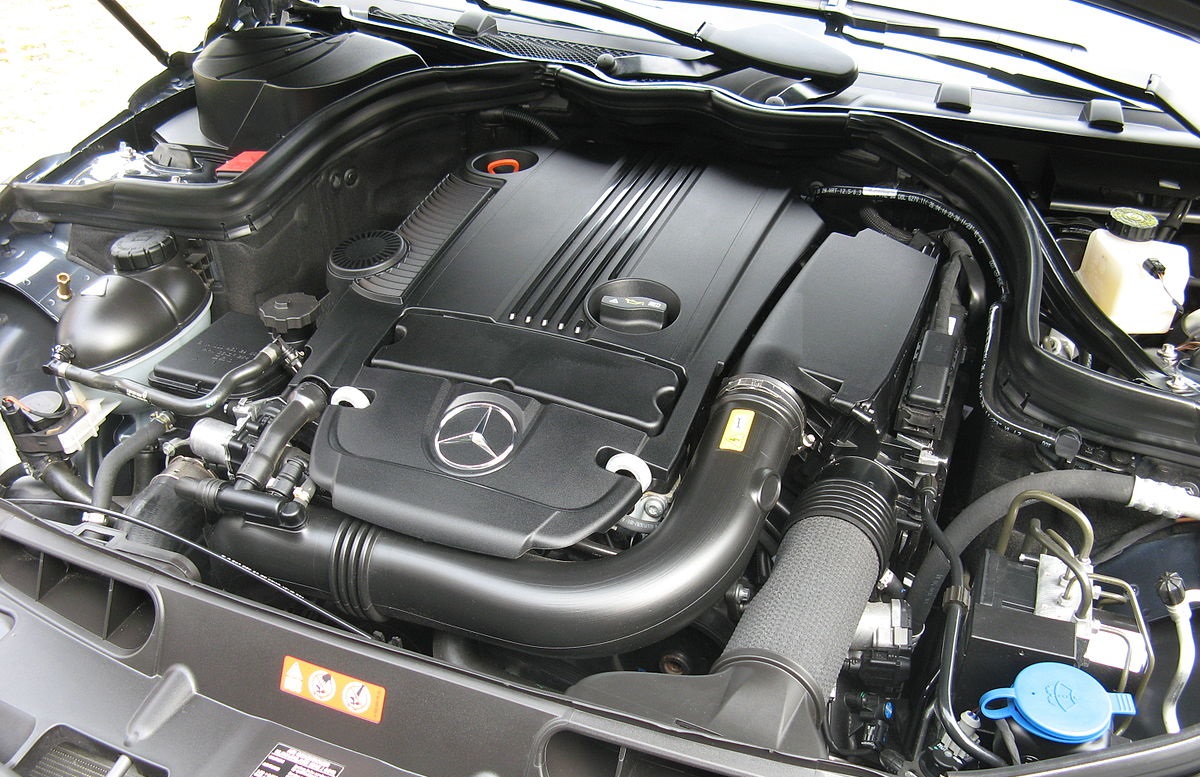
M271 Engine Timing Chain & EVO Faults: Workshop Diagnosis Guide

M271 Engine
M271 Engine

Quick Summary

The Mercedes M271 is a 1.6L and 1.8L inline-4 petrol engine (2002–2015), fitted across the C-Class W203/W204, E-Class W211/W212, SLK R171/R172 and CLK W209. Early units used a supercharger (Kompressor); the later M271 EVO switched to a turbocharger and direct injection. Capable of 200,000+ km with correct servicing — but has well-documented weak points: timing chain stretch and guide wear from neglected oil intervals (P0016, P0017, P0341) — the M271’s single-row chain is the defining fault of the platform; camshaft actuator oil leaks wicking into the wiring harness; and on the EVO specifically: carbon buildup on intake valves (DI), turbo boost hose cracking, and injector faults (P02xx). All preventable with short oil change intervals and early action on any rattle.

Mercedes M271 Kompressor engine technology overview — supercharger (9), timing chain (10), fuel rail (3), piezo injectors (4), ignition system (2), starter (5), cooling fan (8), pistons and crankshaft (7)
M271 Kompressor engine technology overview — (1) supercharger inlet, (2) ignition module, (3) fuel rail, (4) injector, (5) starter motor, (6) variable cam phaser, (7) crankshaft and pistons, (8) cooling fan, (9) supercharger, (10) timing chain assembly

Mercedes M271 Engine — Overview & Variants

The M271 was Mercedes-Benz’s primary small-displacement petrol inline-4 across most of the 2000s and early 2010s. It succeeded the M111 and introduced aluminium construction, DOHC 16-valve architecture, variable cam timing on both camshafts, and chain-driven cams to the compact Mercedes range. The M271 family spans two fundamentally different induction systems — supercharged (Kompressor) and turbocharged (EVO) — which have different performance characteristics, different fault profiles, and different maintenance needs.

Related engines: M274 (direct successor) · M264 (current generation) · Mercedes Engine Types Hub

Variant Displacement Induction Injection Power Torque Years
KE16 ML 1.6L Supercharged Port ~129 PS ~220 Nm 2009–2011
KE18 ML / DE18 ML 1.8L Supercharged Port / Direct 143–184 PS 230–250 Nm 2002–2008
DE18 LA — M271 EVO 1.8L Turbocharged Direct (piezo) 156–204 PS 270–310 Nm 2009–2015
Mercedes M271 engine power and torque curves for three variants — blue (156 PS), green (170 PS), red (204 PS M271 EVO) showing torque from 1,000 rpm and peak power at 5,000-5,500 rpm
M271 EVO power and torque curves across three output levels — blue: 156 PS / 250 Nm, green: 170 PS / 280 Nm, red: 204 PS / 310 Nm. All variants deliver peak torque from under 2,000 rpm

M271 EVO — What Changed & Why It Matters for Diagnosis

The M271 EVO (DE18 LA, 2009–2015) is not simply a revised Kompressor — it is a fundamentally different engine that happens to share the same block. Understanding whether you have the Kompressor or the EVO is essential before diagnosing any fault, because the two engines have different induction systems, different injection systems, different fault codes, and different common failure modes.

Feature M271 Kompressor M271 EVO (Turbo)
Induction Roots-type supercharger — linear boost from idle Single turbocharger — stronger peak torque, slight lag
Injection Port injection — fuel washes intake valves Direct injection (piezo) — no valve wash, carbon builds
Torque 230–250 Nm — usable but modest 270–310 Nm — strong from 1,800 rpm
Efficiency Lower — supercharger driven by engine belt Higher — BlueEFFICIENCY measures, lower fuel use
EVO-specific faults N/A — supercharger belt wear, no boost hoses Carbon buildup, boost hose cracking, injector faults (P02xx)
Shared faults Timing chain, cam actuator leaks, oil consumption Timing chain, cam actuator leaks, oil consumption
Mercedes M271 EVO turbocharger and intercooler system diagram — showing turbo inlet (110/1), intercooler (110/2), charge pipes (110/6), throttle body (M16/6-7), starter (50), alternator (50/1), charge air bypass (122) and fuel pressure regulator (B2/5)
M271 EVO turbo and intercooler layout — turbo inlet (110/1), front-mount intercooler (110/2), charge pipes (110/6 — primary boost hose failure points), throttle (M16/6), charge air bypass valve (122)

M271 Reliability & Lifespan

The M271 is a fundamentally sound engine that has been let down by one specific design weakness: its single-row timing chain. Where the successor M274 uses a dual-row chain and reaches 300,000 km routinely, the M271’s single-row chain is thinner, less robust, and significantly more sensitive to oil quality and change frequency. Early units (pre-2006) are particularly vulnerable — chain stretch has been documented from as low as 60,000 km on neglected examples.

Set aside the chain issue, and the M271 is a durable engine. The aluminium block and head are robust. The supercharger on Kompressor units is reliable when the belt and tensioner are maintained. The EVO’s turbo is durable when oil quality is kept up. Many M271-powered vehicles reach 200,000–250,000 km without internal engine work.

M271 lifespan by variant: The Kompressor variants (KE18 ML) typically reach 200,000–220,000 km before requiring chain attention. The EVO (DE18 LA) can reach 200,000–250,000 km with strict 7,500-mile oil intervals and walnut blast at 100,000 km. Engines with documented, short oil change histories reliably exceed these figures.

✅ Strengths

  • Aluminium block and head — lightweight and robust
  • DOHC 16-valve with variable cam timing both cams
  • 200,000–250,000 km achievable with correct maintenance
  • EVO: stronger torque and better economy than Kompressor
  • Well-understood faults — parts widely available

⚠️ Known Weaknesses

  • Single-row timing chain — M271’s biggest fault
  • Cam actuator oil leaks (Y49/1, Y49/2) into harness
  • Oil consumption and PCV system degradation
  • EVO: carbon buildup (DI), boost hose cracking, injectors
  • Water pump and thermostat failure at higher mileage
Mercedes M271 single-row timing chain assembly — showing primary and secondary chains, cam phasers (variable timing actuators), chain tensioners and oil pump drive chain
M271 timing chain assembly — single-row primary and secondary chains, cam phasers (variable timing), hydraulic tensioners. The thin single-row design is the platform’s defining vulnerability

Common M271 Problems & Fault Codes

Problems 1–3 apply to both Kompressor and EVO variants. Problems 4–5 are EVO-specific. All include confirmed XENTRY or Autel MaxiSys fault codes and live data from workshop cases.

1 — Timing Chain Stretch & Guide Wear (Both variants — M271’s defining fault)

Symptoms: Rattle on cold start (clearing within 30–60 seconds on mild cases, persistent on severe), high-rpm metallic clatter, P0016/P0017 or P0341 stored, rough idle. In severe cases the chain can jump timing, causing valve contact.

Root cause: The M271 uses a single-row timing chain — thinner and less robust than the dual-row chain fitted to the M274 and M276. The chain drives from the bottom of the engine (crankshaft), requiring oil pressure to reach the tensioner quickly on cold starts. If oil is dirty or viscosity has degraded, the tensioner takes longer to build pressure, and the chain runs slack each morning. Early M271 units (pre-2006) also suffered from plastic guide rails that crack and shed fragments into the sump. Updated composite guide materials were introduced mid-production. Extended oil change intervals accelerate failure on all variants.

// XENTRY Fault Memory — C200K W203, 112,000 miles, 14-month oil intervals
P0016   Crankshaft/Camshaft Position Correlation (Bank 1)   ACTIVE
P0341   Camshaft Position Sensor Circuit Range/Performance   STORED
// Live data: cam advance offset +8.4° at idle (limit: 5°)
// Cold start rattle: audible 90 seconds — does not fully clear on cold mornings
// Sump inspection: plastic guide rail fragments confirmed — pre-2006 unit
// Action: full chain set, updated composite guides, tensioner replaced. Rattle eliminated.

Fix: Replace the full chain set with updated parts — chain, tensioner, all guides (use composite/updated guide part numbers, not original plastic). Never replace the chain alone. Inspect the sump for plastic guide debris and clean the pickup screen. The chain must be replaced at first rattle — do not drive on a rattling M271. Full guide: Engine Rattling Noise on Cold Start: Solution.

2 — Camshaft Actuator Oil Leaks (Y49/1, Y49/2) (Both variants)

Symptoms: Check engine light, rough idle, stored misfire codes (P0301–P0304), oil smell from engine, oil residue on spark plug loom, cam phasing codes (P0011, P0014).

Root cause: The M271 uses two camshaft actuator solenoids — Y49/1 (inlet) and Y49/2 (exhaust) — to control variable cam timing. Each solenoid has an O-ring seal that hardens and cracks with age, particularly in the high-temperature environment at the rear of the cylinder head. Oil then tracks along the wiring loom down into the spark plug wells, fouling the coil bases and causing misfires. This is one of the most common M271 faults and is often misdiagnosed as a coil or ignition fault.

// Autel MaxiSys — C180K W204, 78,000 miles
P0301   Cylinder 1 Misfire   ACTIVE
P0303   Cylinder 3 Misfire   STORED
P0014   Camshaft Position — Timing Over-Retarded (Exhaust)   STORED
// Visual: oil tracking from Y49/2 connector along harness loom to plug wells 1 and 3
// Plug wells 1 and 3: oil contamination confirmed, coil bases fouled
// Action: Y49/1 and Y49/2 O-rings replaced, harness cleaned, coils 1 and 3 replaced. All codes clear.

Fix: Replace both Y49/1 and Y49/2 O-rings as a set — never just one. Clean the entire harness loom before reinstalling. Inspect all four plug wells for oil contamination; replace any fouled ignition coils. Do not clear codes and return the car without resolving the root leak — misfires will return within days.

3 — Oil Consumption, PCV Failure & External Leaks (Both variants)

Symptoms: Oil level dropping between services (more than 0.5L/1,000 km), blue smoke on cold start or overrun, oil residue at breather hose connections, oil filler cap area oily.

Root cause: Two primary causes. First: the M271 PCV (positive crankcase ventilation) system uses a membrane valve that degrades with age and heat cycling — a failed PCV membrane raises crankcase pressure, forcing oil through seals and into the intake. Second: valve stem seals harden at higher mileage on both variants, increasing oil consumption on warm engines. External leaks from the oil filter housing gasket and cam cover gasket are also common on higher-mileage units.

// XENTRY — C230 W203, 96,000 miles, consuming 1.2L/1,000 km
P0171   System Lean (Bank 1)   STORED
// Live data: LTFT Bank 1: +14.8% (oil vapour entering intake via PCV)
// Visual: oil residue at breather hose inlet manifold connection
// PCV membrane tested: deflects under 0.02 bar (spec: 0.05+ bar) — failed
// Action: PCV membrane replaced, breather hose and oil filter housing gasket replaced. LTFT +2.1%.

Fix: Replace PCV membrane (separate part on most M271 variants — do not replace the full housing unless cracked). Inspect and replace the oil filter housing gasket and cam cover gasket at the same time — they share a similar failure timeline. Full guide: Oil Leak From Oil Filter Housing: Case Study & Fix.

4 — Carbon Buildup on Intake Valves (EVO DE18 LA only — direct injection)

Symptoms: Rough idle on cold start clearing after 2–3 minutes warm-up, hesitation at part throttle 1,500–2,500 rpm, flat spot on acceleration, reduced fuel economy. The Kompressor does not suffer this fault — its port injection washes the valves with every injection event.

Root cause: The M271 EVO uses piezo direct injection — fuel enters the cylinder directly, bypassing the intake valves. Blow-by gases from the crankcase deposit oil carbon on valve stems and seats over time. At 80,000–100,000 km on short-trip or urban duty cycles the buildup is enough to cause drivability symptoms. Cold rough idle (carbon disrupts low-lift valve sealing on cold startup) is typically the first symptom.

// XENTRY — C250 EVO W204, 94,000 miles (urban use, no walnut blast history)
P0300   Random Multiple Cylinder Misfire   STORED
// Live data: LTFT Bank 1: +12.3% — lean condition from restricted flow
// Rough idle on cold start — clears at 3 min warm-up; hesitation 1,800–2,200 rpm
// Borescope: heavy deposit on valves 2 and 4 — estimated 2–3mm buildup
// Action: walnut blast all 4 intake valves. LTFT dropped to +1.8%, idle smooth cold.

Fix: Walnut blast all four intake valves. Chemical cleaners do not remove baked-on deposits. Recommended interval: every 60,000 miles / 100,000 km, or at first rough cold-idle symptom. Shortening oil change intervals slows deposit formation by reducing blow-by oil content.

5 — Turbo Boost Hose Cracking & Injector Faults (EVO DE18 LA only)

Symptoms (boost hoses): Power loss above 3,000 rpm, turbo lag on acceleration, hissing sound under load, P0299 (underboost). Symptoms often intermittent — hoses open under boost and reseal at idle.

Symptoms (injectors): Rough idle, misfire codes P0201–P0204, limp mode, difficult cold start. The EVO’s piezo injectors require ECU coding after replacement.

Root cause: The EVO’s intercooler charge pipes (110/6 in the diagram above) are silicone-reinforced rubber hoses that develop micro-cracks from repeated heat cycling. The clamp at the turbo outlet is particularly prone to loosening. Injector faults on the EVO are less common but occur — typically from contaminated fuel or extended service intervals where injector deposits accumulate. Piezo injectors require individual coding to the ECU after replacement.

// Autel MaxiSys — C250 EVO W204, 67,000 miles
P0299   Turbocharger Underboost Condition   ACTIVE
// Live data: boost target 1.2 bar, actual 0.7 bar at 3,500 rpm WOT
// Smoke test: leak at turbo outlet charge pipe clamp — 5mm gap under 0.9 bar
// Charge pipe surface: two micro-cracks visible at clamp seating area
// Action: charge pipe set replaced, clamps retorqued. Boost 1.19 bar at same test point.

Fix (boost hoses): Replace the full charge pipe set — not just the cracked section. Retorque all clamps to specification. Annual boost pressure test recommended. Full guide: Boost Leak Check: 4 Steps to Solution. Fix (injectors): Replace with OEM-spec piezo injectors and code each injector to the ECU via XENTRY — uncoded injectors cause worse misfires than the originals.

M271 Problem Frequency by Model

Mercedes M271 EVO engine component diagram — ignition coils T1/1-T1/4, cam position sensors B6/15 B6/16, cam actuators Y49/1 Y49/2 (primary oil leak failure points), coolant temp sensor B11/4, knock sensor 126
M271 EVO component detail — ignition coils T1/1–T1/4, cam sensors B6/15–B6/16, cam actuators Y49/1 and Y49/2 (primary oil leak source), coolant temp sensor B11/4, knock sensor 126
Model Variant Most Frequent Issue Notes
C-Class W203 (C180/200/230K) KE18 ML Kompressor Timing chain (early plastic guides), cam actuator leaks Pre-2006 units: inspect guides urgently — plastic fragments in sump
C-Class W204 (C180/200/250 EVO) DE18 LA M271 EVO Carbon buildup, timing chain, boost hose cracking Most case study data available — highest volume M271 EVO application
E-Class W211/W212 KE18 ML / DE18 LA Timing chain, oil consumption, PCV Higher mileage examples — chain and PCV reach failure together
SLK R171/R172 · CLK W209 KE18 ML / DE18 LA Cam actuator leaks, chain (R171 early units) Lighter vehicles — chain stress lower, but same failure timeline

Workshop Case Studies — M271 Engine

Two confirmed cases on M271-powered vehicles, with full scan data, diagnostic steps and confirmed outcome.

CASE 01

C200K W203 — Cold Start Rattle + Chain Jump

Vehicle: Mercedes C200 Kompressor (W203), M271 KE18 ML, 112,000 miles, oil changed every 12–14 months (irregular history)

Customer complaint: Loud rattle on cold start every morning — worse than a diesel. Does not fully clear. Check engine light on for 3 weeks. Occasional rough running at idle.

Scan result: P0016 active, P0341 stored

Diagnostic steps:

  1. XENTRY scan — P0016 active, P0341 stored. Cam advance offset at idle: +8.4° (limit: 5°)
  2. Cold start rattle confirmed — audible for 90 seconds, partially clearing at full operating temp
  3. Engine oil inspected: dark, slightly thickened — consistent with 14-month interval
  4. Sump drain plug removed and drain pan inspected — plastic guide fragments present
  5. Timing cover removed: primary chain slack 14mm on tensioner side (spec: max 6mm), guide rail cracked in two places

Repair: Full chain set replaced with updated composite guide part numbers. Tensioner replaced. Sump cleaned of guide debris. Fresh MB 229.5 5W-40 fitted.

Result: No rattle on next five cold starts. P0016 and P0341 cleared, no recurrence at 6-week follow-up. ✅

→ Full article: Engine Rattling Noise on Cold Start Mercedes  |  How to Diagnose Engine Noises

CASE 02

C250 EVO W204 — Cold Misfire + Won’t Start

Vehicle: Mercedes C250 EVO (W204), M271 DE18 LA, 88,000 miles

Customer complaint: Engine misfiring badly on cold start every morning — clears after 5 minutes. On one occasion failed to start at all (cranked but would not fire). Oil smell from engine bay when warm.

Scan result: P0301, P0303 active; P0014 stored

Diagnostic steps:

  1. Autel MaxiSys — P0301, P0303 active; P0014 stored. Misfire counters: cyl 1 = 1,240, cyl 3 = 890 last 20 drive cycles
  2. Spark plug wells inspected — heavy oil contamination in wells 1 and 3; coil bases oil-fouled
  3. Oil tracking source: Y49/2 (exhaust cam solenoid) O-ring cracked — confirmed visually
  4. Y49/1 O-ring inspected — surface cracking present, not yet leaking but at failure threshold
  5. Spark plugs 1 and 3 removed — electrode area oil-contaminated, gap worn beyond spec

Repair: Both Y49/1 and Y49/2 O-rings replaced. Wiring loom cleaned with brake cleaner and dried. Ignition coils 1 and 3 replaced. Spark plugs 1 and 3 replaced (remaining two inspected — within spec). Plug wells sealed and cleaned before reassembly.

Result: Clean cold start on next morning test. No misfires over 5 drive cycles. Oil smell eliminated. No recurrence at 4-week recheck. ✅

→ Full article: Engine Misfire When Cold: Case Study & Solution  |  Why Won’t My Mercedes Start? M271 Case Study

M271 Oil Capacity & Spec

Mercedes M271 Kompressor engine component diagrams — injectors Y62/1-4, throttle actuator M16/6-7, ECU N3/10, alternator A16/1 and A16/4, temperature sensor B17, coolant sensor L5, supercharger M16/7
M271 Kompressor component layout — injectors Y62/1–4, throttle M16/6–7, ECU N3/10, alternator A16/1 and A16/4, temp sensor B17, supercharger drive M16/7
Variant Capacity (with filter) Approved Spec Viscosity Interval
M271 Kompressor (KE16/KE18) ~5.5 L MB 229.5 / 229.3 0W-40 or 5W-40 5,000–7,500 mi / 8–12 months
M271 EVO (DE18 LA) ~5.5 L MB 229.5 / 229.3 0W-40 or 5W-40 5,000–7,500 mi / 8–12 months
Workshop note: The M271 requires a shorter oil change interval than Mercedes’s factory service indicator suggests. The single-row timing chain is highly sensitive to oil quality — degraded oil allows tensioner bleed-down overnight and accelerates chain stretch. Maximum 7,500 miles for normal use; 5,000 miles for urban/short-trip driving, hot climates, or if the chain has been replaced. Always confirm exact capacity with the dipstick — fill to 5.5L and check. Always use MB 229.5 or 229.3 spec only.

M271 Maintenance Checklist

Task Interval Priority
Oil & filter — MB 229.5/229.3 5,000–7,500 mi maximum — do not extend beyond factory indicator Critical
Timing chain cold-start listen Every cold start — act immediately at first rattle, do not drive on Critical
Cam actuator O-rings (Y49/1, Y49/2) inspection At first oil smell or misfire, or 60,000 miles preventively Critical
Walnut blast — intake valves (EVO only) 60,000 miles / 100,000 km or at first cold rough-idle symptom High (EVO)
PCV membrane and breather hoses Every service inspection, replace at first sign of oil in intake High
Boost hose inspection (EVO only) Annual or at first power loss / hissing symptom High (EVO)
Water pump and thermostat At first coolant symptom or 100,000 miles preventively High
Spark plugs 30,000–40,000 miles (shorten if misfire history or cam leak repaired) Standard

M271 Tuning Potential

The M271 EVO (DE18 LA) has genuine tuning potential thanks to its direct injection and turbo setup. The Kompressor variants are less tuning-friendly — the supercharger output is harder to increase without hardware changes.

Mercedes M271 EVO real engine photograph showing ECU SIM271DE2.0 label, N3/10 (engine control module), B28/6 (crankshaft position sensor), B17/8 (coolant temp sensor), M1 (starter motor), A9 (battery)
M271 EVO — ECU SIM271DE2.0 (N3/10), crankshaft position sensor B28/6 and B28/7, coolant temp B17/8, alternator A16/1, starter M1, knock sensor B70
  • Stage 1 ECU remap (EVO): 200–220 PS achievable on a stock turbo with supporting mods. Fuel trims stay manageable. Warranty voided.
  • Safe ceiling on stock internals: 300–350 PS is achievable on well-tuned EVO setups with intercooler, exhaust and turbo upgrade. Beyond this, forged pistons and rods are recommended.
  • Caution: More power increases heat and chain/valvetrain stress significantly. Reduce oil change interval to 4,000 miles on tuned cars. Walnut blast interval to 50,000 miles.
  • Kompressor: Supercharger pulley swap for modest gains. Much less headroom than the EVO — the Roots blower is the limiting factor, not the engine.

M271 vs M274 vs M264

Engine Years Induction Chain Key Weakness Verdict
M271 2002–2015 SC or turbo (EVO) Single-row — sensitive Timing chain (defining fault) Capable — requires short oil intervals and chain vigilance
M274 2012–2019 Turbo Dual-row — much more durable Thermostat, cam actuator, DI carbon Significant improvement — better chain, more torque, 300,000 km capable
M264 2017–present Twin-scroll turbo + 48V Dual-row + EQ Boost 48V system complexity, newer Best technology — inline-6 smoothness in a 4-cyl, highest cost

Which Cars Have the M271 Engine?

  • C-Class W203 — C180, C200, C230 Kompressor
  • C-Class W204 — C180, C200, C250 (Kompressor / EVO)
  • E-Class W211 / W212 — E200, E250 (market-dependent)
  • SLK R171 / R172 — SLK 200, SLK 250
  • CLK W209 — CLK 200 Kompressor
🔗

Explore All Mercedes Engine Types

The M271 sits between the older M111 and the improved M274 and M264 in the Mercedes inline-4 petrol timeline. Compare specs, reliability ratings and fault patterns across all Mercedes petrol and diesel engines in our complete guide.

→ Mercedes Engine Types Hub

FAQs — Mercedes M271 Engine

Is the Mercedes M271 a reliable engine?

Yes — with strict oil change intervals and early action on any chain rattle. The M271 is a capable engine that reaches 200,000–250,000 km regularly when maintained correctly. The single-row timing chain is its defining weakness, but it is a manageable and predictable failure when caught early. The M271 EVO additionally requires walnut blasting at 100,000 km and annual boost hose inspection.

What is the M271 engine lifespan? (m271 motor ömrü)

With correct oil change intervals (5,000–7,500 miles maximum, not the factory extended interval) the M271 Kompressor reliably reaches 200,000–220,000 km and the EVO 200,000–250,000 km before requiring major work. Engines with documented, short-interval service histories regularly exceed these figures. Neglected oil intervals reduce this to 100,000–130,000 km before chain failure.

What is the difference between M271 and M271 EVO?

The M271 Kompressor uses a roots-type supercharger with port injection — fuel washes the intake valves on every injection event. The M271 EVO (DE18 LA, 2009–2015) replaces the supercharger with a turbocharger and adds direct injection (piezo injectors). The EVO produces more torque (270–310 Nm vs 230–250 Nm), is more fuel-efficient, but adds EVO-specific faults: carbon buildup on intake valves, boost hose cracking, and piezo injector issues. The timing chain weakness is shared by both.

Does the M271 have timing chain problems?

Yes — timing chain stretch is the M271’s most documented fault. The single-row chain is thinner and less robust than the dual-row chain used in the M274 and M276. Chain stretch is almost always caused or accelerated by extended oil change intervals. Pre-2006 units also used plastic guide rails that crack and shed debris into the sump — these should be replaced with updated composite guides. Fault codes: P0016, P0017, P0341. Act immediately at first rattle — do not drive on a rattling M271.

What fault codes are common on the M271?

Most frequent: P0016/P0017/P0341 (timing chain — cam/crank correlation), P0301–P0304 (misfires — usually cam actuator O-ring oil leak into plug wells), P0011/P0014 (cam actuator phasing — Y49/1 or Y49/2 failure), P0171 (lean — PCV membrane failure), P0300 (random misfire from DI carbon buildup — EVO only), P0299 (underboost — boost hose crack — EVO only).

What oil should I use in the M271, and how often should I change it?

MB 229.5 or 229.3 approved fully synthetic — 0W-40 or 5W-40. Change every 5,000–7,500 miles or 8–12 months maximum. Do not follow the factory service indicator for oil on the M271 — the extended interval was set for comfort, not for chain protection. Shortening oil changes is the single most effective maintenance step for M271 longevity.


— Salim, Mercedes Expert
Independent specialist in Mercedes-Benz diagnostics, CAN Bus analysis, troubleshooting case studies, and EV systems.