

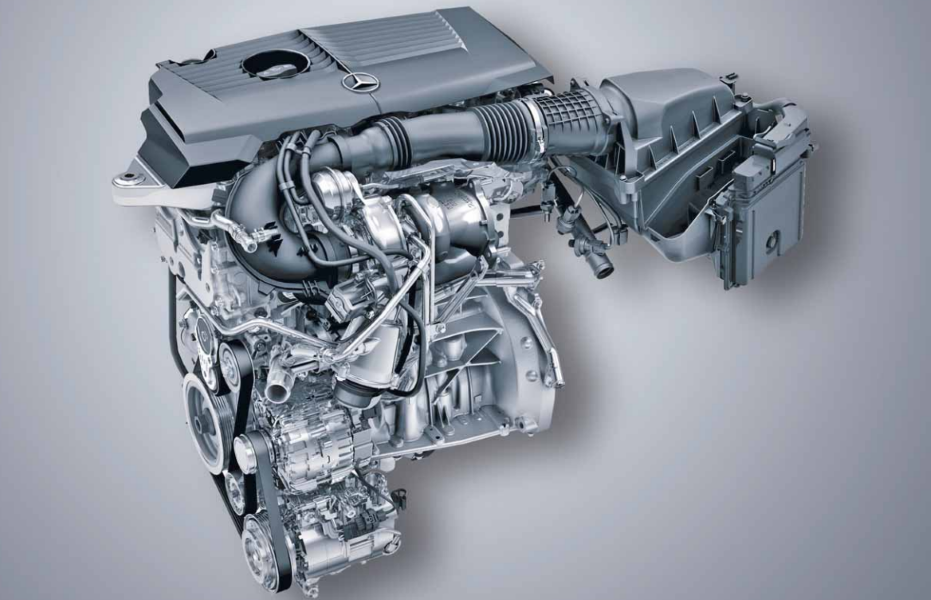

M270 Specifications & Variants
The M270 covers two displacements — 1.6L (DE16 LA) and 2.0L (DE20 LA) — sharing the same block architecture but with different bore, stroke, and turbo calibrations. Both use direct injection, twin-scroll turbocharging, and dual variable valve timing.
| Variant | Displacement | Power | Torque | Applications |
|---|---|---|---|---|
| M270 DE16 LA | 1.6L | 75–90 kW (101–121 hp) | 180–200 Nm | A180, B180, CLA180, GLA180 |
| M270 DE20 LA | 2.0L | 115–160 kW (154–215 hp) | 270–350 Nm | A200/250, CLA200/250, GLA200/250 |

M270 Reliability — Honest Assessment
The M270 is a fundamentally sound engine. 200,000 km examples are common across all platforms. However, it has specific failure patterns that are entirely predictable — and entirely preventable with the right maintenance approach.
Strengths: Smooth power delivery, genuine fuel efficiency (particularly the 1.6L), compact transverse packaging, strong low-end torque from the twin-scroll turbo, and all-aluminium block for low weight.
Weaknesses: The dual-stage timing chain system requires more attention than a single-chain setup. Carbon buildup is an inherent trait of all direct-injection petrol engines — the intake valves are not washed by fuel, so deposits accumulate over time regardless of oil quality.
Common M270 Engine Problems — Workshop Reality

The M270’s most critical failure point. It uses a two-stage chain system: an upper chain connecting crankshaft to both camshafts (with variable cam phasers Y49/1 and Y49/2), and a lower chain driving the oil pump and balance shaft. Both chains, guides, and tensioners must be assessed together.
Workshop observation: The cold-start rattle is the definitive early warning — metallic clatter for 5–15 seconds after start-up that disappears as oil pressure builds. Ignored, the guide plastic degrades and the chain can skip a tooth — causing camshaft timing errors, misfires, and in worst cases valve contact.
Why it happens earlier on short-trip vehicles: The chain tensioner relies on oil pressure. Cold starts with insufficient warm-up leave the tensioner under-pressurised repeatedly, accelerating guide wear. Urban short-trip drivers see issues from 70,000–80,000 km; motorway drivers often reach 120,000–140,000 km without problems.
Fix: Full kit — upper chain, lower chain, all guides, both tensioners, cam phaser sprockets if worn. Never replace chains without guides or vice versa.
→ Real case study: Why Does Engine Light Come On
The cam phasers are hydraulically controlled by solenoid valves Y49/1 (exhaust cam) and Y49/2 (intake cam). Wear in the phaser mechanism causes a characteristic ticking on cold start — lighter and higher-pitched than timing chain rattle, disappearing faster as oil pressure builds.
Updated part: Mercedes issued updated camshaft actuator A2700501147 with improved wear resistance. Always fit the updated version. A sticking solenoid valve (Y49/1 or Y49/2) is sometimes the root cause — clean or replace the solenoid before condemning the full actuator.
→ Real case study: Car Jerks and Loses Power While Driving
An inherent characteristic of all direct-injection petrol engines. Fuel is injected directly into the combustion chamber — intake valves are never washed by fuel spray. Oil vapour from crankcase ventilation coats the valve stems and accumulates as hard carbon deposits over time.
Symptoms: Misfires at specific cylinders, rough cold idle, hesitation on acceleration, slight power loss. Noticeable from 60,000–80,000 km, significant from 100,000 km onwards.
Fix: Walnut blasting — intake manifold removed, walnut shell media blasted at intake valves through intake ports. Physical removal of deposits. 2–4 hours workshop time. Fuel additives do not work — fuel never contacts the intake valves on direct injection engines.
The M270 thermostat uses a map-controlled (electronically actuated) housing — component Y133 — rather than a traditional wax-element thermostat. The housing is prone to coolant seepage as the plastic ages. First symptom is often a sweet smell from the engine bay or slow coolant level drop with no puddle visible (coolant evaporates on hot surfaces).
Workshop observation: Temperature gauge fluctuation — swinging between normal and slightly cool — indicates the thermostat is beginning to stick open as the housing degrades. Replace the complete assembly with OEM part. Aftermarket housing replicas have a high failure rate on M270.
→ Real case study: Thermostat Housing Leak→ Real case study: Is It Normal for Coolant Level to Drop?

Valve cover gasket leaks are common from ~100,000 km. On the M270’s transverse layout, oil drips onto the hot exhaust — first symptom is a burning oil smell, not a visible puddle. The M270 oil pan also houses the Y130 oil pump control valve and S43 oil level sensor — the same Y130 system that causes the P06DA00 fault on M274 engines.
→ Real case study: Oil Mixing With Coolant

Failure Timeline: What Breaks & When
Real Workshop Case Studies — M270 Faults
M270 Maintenance Schedule & Oil Specification
| Task | Interval | Workshop Notes |
|---|---|---|
| Engine oil & filter | 10,000 km max (8,000 km recommended) | MB 229.5 or 229.51 only. Shorter intervals protect timing chain tensioner. |
| Air filter | 20,000–30,000 km | Clogged filter starves turbo and accelerates carbon buildup from rich running. |
| Spark plugs | 30,000–40,000 km | OEM Bosch or NGK. Worn plugs accelerate carbon from incomplete combustion. |
| Timing chain inspection | From 80,000 km or at first cold-start rattle | Inspect both upper and lower chain systems together. Do not wait for symptoms over 100,000 km. |
| Walnut blast (intake valves) | Every 60,000–80,000 km | Non-negotiable on direct injection. Fuel additives not effective — physical cleaning only. |
| Camshaft actuator | At 60,000 km if ticking | Fit updated A2700501147. Clean solenoids Y49/1 and Y49/2 before replacing mechanical actuator. |
| Thermostat housing | Every service from 80,000 km | Check for coolant residue. Replace complete OEM assembly — not just the element. |
| Serpentine belt & tensioner | 80,000–100,000 km | Or at any sign of cracking, glazing, or chirping. |
| Coolant flush | Every 4–5 years | MB-approved only. Never mix coolant types. |
Oil Specification
- Specification: MB 229.5 or MB 229.51 fully synthetic
- Viscosity: 0W-40 or 5W-30 depending on climate — check your handbook
- Capacity: 5.8–6.0 litres including filter
- Interval: Maximum 10,000 km — 8,000 km for urban/short-trip use
- Never use: Non-MB-approved oil — reduces timing chain tensioner longevity
All Models Using the M270 Engine
M270 vs M274 — Key Differences
The M270 and M274 share the same engine family — same architecture, same injection system, same known weak points. The key difference is layout and application.
| Feature | M270 | M274 |
|---|---|---|
| Layout | Transverse (FWD) | Longitudinal (RWD/4MATIC) |
| Applications | A-Class, B-Class, CLA, GLA | C-Class, E-Class, GLC, GLE |
| Displacement | 1.6L and 2.0L | 2.0L only |
| Output range | 101–215 hp | 154–241 hp |
| Timing chain | Dual-stage — upper + lower | Dual-stage — same design |
| Carbon buildup | Same — direct injection trait | Same — direct injection trait |
| Oil pump valve | Y130 — same as M274 | Y130 — P06DA00 fault code |
| Interchangeable? | No — different mounts, gearbox interface, and cooling layout | |
Frequently Asked Questions — Mercedes M270 Engine
— Salim, Mercedes Expert
Independent specialist in Mercedes-Benz diagnostics, CAN Bus analysis, troubleshooting case studies, and EV systems.