

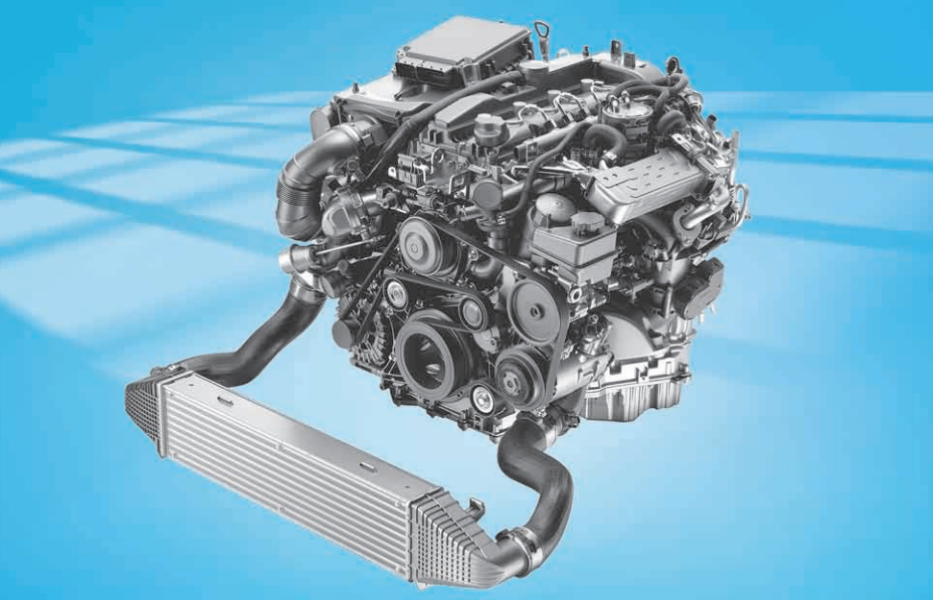

Engine Specifications & Variants
The OM651 family spans 11 years of production (2008–2019) and over a dozen output variants. The core architecture is consistent — 2,143 cc inline-4 DOHC common-rail diesel — but turbocharger configuration and ECU calibration vary significantly between applications.
Power & Torque by Variant
| Badge / Variant | Power | Torque | Turbo | Notes |
|---|---|---|---|---|
| 200 CDI / 200d | 95–136 hp | 250–330 Nm | Single | Entry tune — C-Class, A-Class, Sprinter |
| 220 CDI / 220d | 136–170 hp | 300–400 Nm | Twin | Most common — W204, W212, GLC, Vito |
| 250 CDI / 250d | 170–204 hp | 400–500 Nm | Twin | Top output — W212, W205, GLC 250d |
| Sprinter variants | 95–190 hp | 300–440 Nm | Single/Twin | Durability-biased calibration for commercial use |

Common Problems by Mileage — Workshop Reality
After years of working on OM651 engines across multiple platforms — W205 C-Class, W212 E-Class, GLC, and Sprinter — the failure pattern is highly predictable. The engine is not unreliable, but it has specific weak points that appear at consistent mileage milestones. Knowing them in advance is the difference between a £200 prevention job and a £2,000 repair.
The OM651’s single most critical failure point. The timing chain drives both camshafts and the high-pressure fuel pump — if it stretches beyond tolerance or a guide fails, the consequences range from misfires and cam/crank correlation codes to catastrophic engine damage if the chain jumps a tooth.

Workshop observation: The tell-tale sign is a cold-start rattle that disappears after 10–20 seconds as oil pressure builds. Many owners dismiss this as “just how diesels sound.” It is not — it is the chain slapping under low tension before the hydraulic tensioner pressurises. At this stage, replacement is still straightforward. Ignore it and you risk guide failure under load.
Diagnosis: Stethoscope at the timing cover, scan for P0016/P0017 (cam/crank correlation). XENTRY live data shows camshaft position deviation beyond spec.
Fix: Full kit replacement — chain, upper and lower guides, tensioner, and sprockets. Do not replace chain only; worn guides will destroy a new chain within 30,000 km.
→ Real case study: Rattling Sound When AcceleratingEarly OM651 engines (pre-2012) used Delphi piezo injectors which developed a reputation for rough idle, limp mode, and high-pressure rail faults. The failure mode is typically injector return flow (leak-off) exceeding specification — causing the ECU to trim fuelling until it triggers limp mode.

Workshop observation: Post-2012 engines used magnetic solenoid injectors which are significantly more durable. If you are buying a used OM651, the injector type is one of the most important questions to ask. A leak-off test takes 20 minutes and will immediately confirm injector health.
Diagnosis: Read P02xx fault codes, perform manual leak-off test with graduated containers — measure return volume from each injector simultaneously.
Fix: Replace failing injectors individually or as a set. Post-replacement, XENTRY injector quantity adjustment (IQA) calibration is mandatory.
→ Real case study: Huge Engine Miss→ Real case study: Mercedes Keeps Losing Power
The EGR (Exhaust Gas Recirculation) valve recirculates exhaust gas back into the intake to reduce NOx emissions. On the OM651, soot accumulation on the valve and intake manifold is accelerated by short-trip urban driving where exhaust temperatures never get high enough for self-cleaning.

Workshop observation: Sprinter and Vito vans doing urban delivery routes are the worst-affected. We typically see EGR cleaning requirements at 60,000–80,000 km on these vehicles versus 100,000–120,000 km on passenger cars with regular motorway use.
Diagnosis: Visual inspection of EGR valve (soot coating), XENTRY EGR command test — valve should open/close smoothly. Hesitation on acceleration and rough idle at warm idle are classic symptoms.
Fix: Chemical clean if caught early. Replace EGR valve if actuator motor has failed. Clean intake manifold simultaneously — there is no point cleaning the EGR and leaving the manifold coked.
→ Real case study: Mercedes Keeps Losing PowerThe OM651 water pump is driven by the serpentine belt system and is a known age/mileage wear item. Failure modes are bearing wear (audible whine/growl) and shaft seal leaks. Because the pump is belt-driven, a seized pump can cause belt failure — which then affects alternator and AC compressor simultaneously.

Workshop observation: The first sign is usually a small coolant seep from the weep hole at the bottom of the pump body — often only visible as white residue after the coolant evaporates. UV dye leak detection is the most reliable method on a hot engine.
Fix: Replace pump, inspect and replace thermostat if suspect, flush coolant. Always use MB-approved coolant — mixing types causes corrosion that accelerates future leaks.
→ Real case study: Where Does Engine Coolant Go?External oil leaks on the OM651 most commonly come from the camshaft cover gasket (valve cover) and the rear crankshaft seal. The camshaft cover gasket is straightforward — often the first oil leak owners notice as a burning smell from oil dripping onto the turbo manifold. The rear crankshaft seal is more involved, requiring gearbox removal on most platforms.
Fix: Camshaft cover gasket is a DIY-possible job. Rear seal requires professional access. Always identify the leak source precisely before quoting — these are very different jobs in cost and labour.
→ Real case study: Engine Is Leaking Oil→ Real case study: Excessive Oil Consumption
Euro 6 OM651 variants add AdBlue SCR to the DPF aftertreatment system. The most common faults are: DPF clogging from short-trip driving that never completes a passive regeneration cycle, and NOx sensor failures that trigger AdBlue-related warning messages.
Workshop observation: A DPF that has been force-regenerated more than 3–4 times without a root cause fix (usually EGR or injector issues causing high soot load) is unlikely to survive cleaning — replacement becomes necessary.
→ Real case study: Diesel Particulate Filter Problems→ Real case study: AdBlue System Fault
Turbocharger failures on the OM651 are usually secondary to other issues — most commonly contaminated oil from extended service intervals, or oil starvation from a blocked oil feed pipe. A turbo that fails due to oil contamination will fail again if the root cause is not fixed first.
Diagnosis: Shaft play check (axial and radial), boost pressure test, smoke test for intercooler leaks. Whistle under boost indicates compressor wheel contact.
Fix: Turbo replacement or overhaul. Always inspect and replace oil feed pipe, clean oil return pipe, and perform oil flush before fitting a replacement unit.
Failure Timeline: What Breaks & When
Based on real workshop experience across hundreds of OM651 engines, here is the honest failure timeline by mileage:
Turbo System: Single vs Twin-Turbo Explained
One of the most common questions about the OM651 is whether it is twin-turbo. The answer depends on the specific variant.

Single Turbo (200 CDI/d variants)
Entry-level OM651 engines use a conventional single variable-geometry turbocharger. Simpler to maintain, easier to diagnose, and the turbo itself is less expensive to replace. Suited to economy-focused driving and commercial applications where simplicity matters more than performance.
Twin-Turbo / Bi-Turbo (220 CDI/d and 250 CDI/d)
Higher-output OM651 variants use a sequential twin-turbo setup. A small high-pressure (HP) turbocharger delivers boost from low rpm — eliminating the lag typical of large single turbos — while a larger low-pressure (LP) turbocharger takes over at higher engine speeds for sustained power. The system is controlled by the ECU via a switchover valve.

Care tips for both systems: clean air filtration is critical (a clogged air filter starves the compressor), oil changes on schedule prevent bearing deposit buildup, always allow a cool-down idle period after sustained motorway or towing use before switching off the engine.
All Mercedes Models Using the OM651
The OM651 was one of Mercedes-Benz’s most widely deployed engines — found in everything from compact hatchbacks to 3.5-tonne commercial vans. Here is the full model coverage:
Passenger Cars
Vans & Commercial
Real Workshop Case Studies — OM651 Faults
Each link below is a real case study from our workshop — specific vehicle, specific fault, specific fix. These are the OM651 problems we see most frequently:
OM651 Maintenance Schedule
The OM651 rewards disciplined maintenance. The failures described above are almost entirely predictable and preventable — what follows is the schedule we recommend based on real workshop experience, not just the owner’s manual.
| Task | Interval | Workshop Notes |
|---|---|---|
| Engine oil & filter | 10,000–12,000 km max | Use MB 229.51/229.52 low-SAPS only. The manual says 15,000 km — we recommend shorter for DPF longevity and timing chain protection. |
| Fuel filter | 30,000–40,000 km | Critical for injector and HP pump longevity. Do not skip on older high-mileage engines. |
| Air filter | 20,000–30,000 km | Shorten on dusty roads. A clogged air filter is the fastest way to kill a turbo. |
| Timing chain inspection | From 120,000 km, or at first rattle | Do not wait for symptoms on high-mileage engines. Cold-start rattle = inspect immediately. |
| EGR & intake clean | 80,000–100,000 km | More frequent on urban/van use. Combine with fuel filter change to save labor. |
| Water pump & thermostat | Inspect every service from 100,000 km | Look for weep hole residue, coolant staining, bearing noise. Replace at first sign. |
| Serpentine belt & tensioner | 80,000–100,000 km | Or at any sign of cracking, fraying, or chirping. Belt failure affects pump, alternator, and AC simultaneously. |
| Coolant flush | Every 4–5 years | Use only MB-approved coolant. Never mix types — corrosion accelerates dramatically. |
| AdBlue top-up | Check every 10,000 km | Low AdBlue triggers progressive power limits then a no-start condition. Keep above 20% at all times. |
| DPF status check | Every XENTRY scan | Monitor soot load percentage. Force regen if over 80% — do not wait for a warning light. |
| Injector leak-off test | At 100,000 km, then every 50,000 km | Especially important on pre-2012 engines with Delphi piezo injectors. 20-minute test that can prevent a £1,500 repair. |

Oil Specification Summary
- Specification: MB 229.51 or MB 229.52 (low-SAPS, DPF-safe)
- Viscosity: 5W-30 for cold climates / 5W-40 for hot conditions or heavy commercial duty
- Never use: High-ash or non-low-SAPS oil — accelerates DPF clogging significantly
- AdBlue: Keep topped above 20%. Low fluid triggers power limits before a no-start.
OM651 vs OM654 vs OM646 — Which Is Better?
The OM651 sits between two generations of Mercedes diesel. Here is the honest comparison:
| Feature | OM646 | OM651 | OM654 |
|---|---|---|---|
| Era | ~2002–2010 | 2008–2019 | 2016–present |
| Block | Cast iron | Aluminium (lightweight) | All-new aluminium design |
| Induction | Single turbo | Single / twin-turbo | Advanced single/two-stage |
| Emissions | Euro 3–4 | Euro 5/6 (DPF/SCR) | Euro 6d ready |
| Power range | ~88–150 hp | 95–204 hp | 150–200+ hp |
| Main weak points | Simpler, more robust | Timing chain, injectors, EGR | Fewer reported issues |
| Overall verdict | Durable & simple | Strong but needs maintenance | Best efficiency & refinement |
Verdict: The OM651 modernised the 2.1L platform with genuine performance and Euro 6 compliance. The OM654 improves on everything — efficiency, refinement, and serviceability — but the OM651 remains an excellent engine when properly maintained. If you are considering a used Mercedes diesel, an OM651 with documented service history and known timing chain replacement is a very solid choice.
Frequently Asked Questions — OM651 Engine
— Salim, Mercedes Expert
Independent specialist in Mercedes-Benz diagnostics, CAN Bus analysis, troubleshooting case studies, and EV systems.